
Juniata County Court Records After a Jail Arrest
The court pathway after a Juniata County arrest normally moves from booking and preliminary arraignment to a docket in Magisterial District Court and, for more serious matters, the Court of Common Pleas. Juniata County is part of Pennsylvania's 41st Judicial District with Perry County. The District Attorney is Cory J. Snook, and the official county description says the District Attorney initiates criminal complaints and prosecutes criminal matters in the name of the Commonwealth. That prosecution role is why booking allegations and formal court charges are not always identical.
Juniata County does not operate its own current county prison. People committed to local jail custody are housed at Mifflin County Correctional Facility, while the charges and court events are tracked through Pennsylvania court dockets. For custody-side details, use jail inmate records; for the limits on booking photos, use jail mugshots. Court records after an arrest focus on docket numbers, charge lists, bail actions, hearing dates, dispositions, and the current status of each count.
The Juniata County Courthouse is listed at 26 N. Main Street, Mifflintown, PA 17059, with court hours of Monday through Friday, 8:00 a.m. to 4:30 p.m. The official 41st Judicial District page lists Kenneth A. Mummah as President Judge, Andrew J. Bender as Judge, and Christina L. Zook as Court Administrator. Local court offices matter when an older file is not available online, but the statewide UJS Case Search portal is the central public starting point for docket sheets.
How to Find Juniata County Court Records After an Arrest
Pennsylvania UJS Case Search is the central public docket source for Juniata County criminal cases. The Pennsylvania courts describe the portal as a free public service for reviewing docket sheets and individual case information. The portal is separate from the jail facility and does not replace MCCF custody channels, but it is the place to check formal charges, charge grades, docket events, bail entries, dispositions, and case status.
The UJS case-search interface allows a search by participant or defendant name, docket number, county, court type, and date range. Use the county filter for Juniata when possible because common names can return results from across Pennsylvania. For a very recent arrest, Magisterial District Court entries may appear first because preliminary arraignment and preliminary hearing activity often start at that level before a case is held for Common Pleas.
- Open Pennsylvania UJS Case Search and choose criminal docket search options that fit the known information.
- Search by defendant name, docket number, or a narrowed date range, then filter to Juniata County when the portal allows it.
- Open the docket sheet and review the filing date, court office, participant name, charge list, bail action, and scheduled events.
- Check each charge's statute, grade, count number, and current status instead of assuming the first listed charge is the final outcome.
If the lower-court case shows that charges were held for court, search again for a Common Pleas docket. A docket may also show cross-court references between a Magisterial District case and a Court of Common Pleas case. For older or unavailable files, contact the Juniata Prothonotary or Clerk of Courts for court records, or the appropriate Magisterial District Court for lower-court records. Court-record access rules are not the same as a Right-to-Know Law request to a county agency.
The official Pennsylvania UJS Case Search page is the statewide docket portal used for Juniata County criminal case lookup.
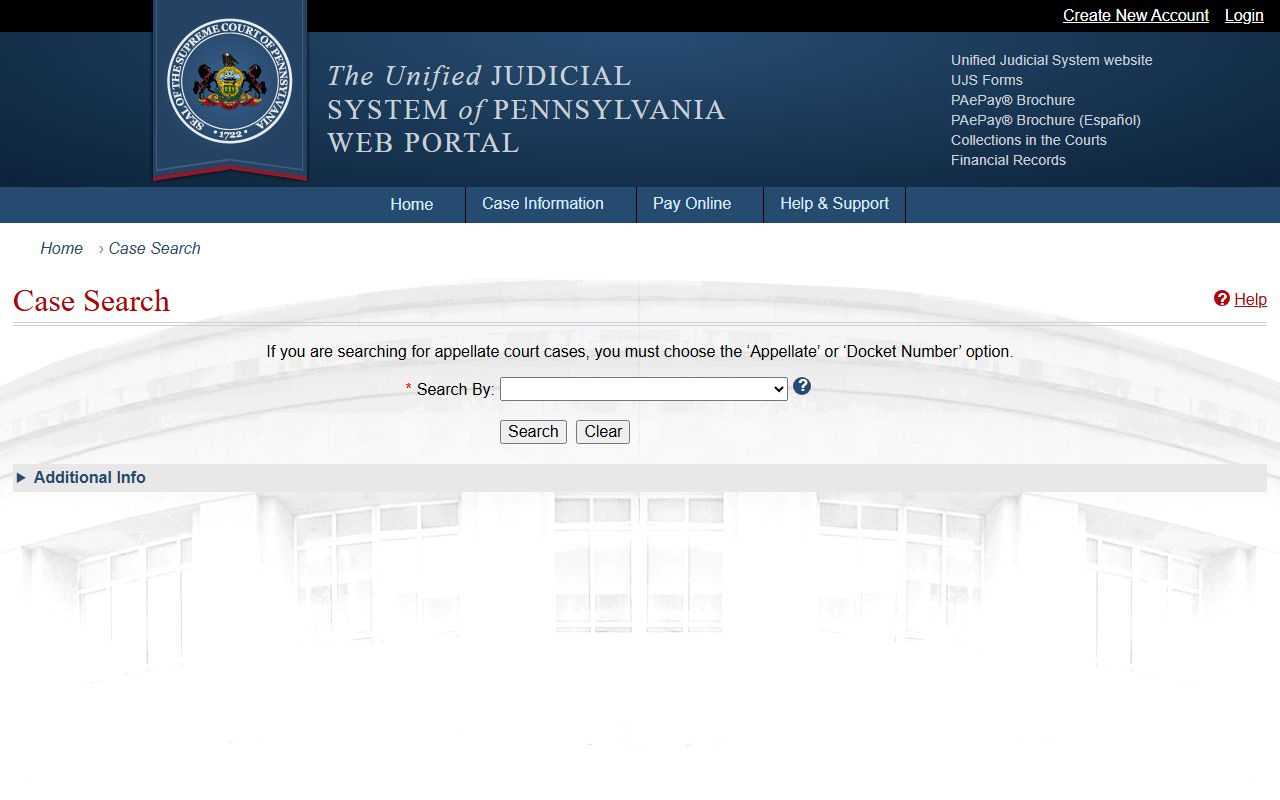
The screenshot is useful because it shows the statewide court-search path, not a jail roster. A person may be in MCCF custody while the docket information is maintained through the Pennsylvania court system.
How Charges Get Filed After an Arrest: Complaint, Information, and Indictment
After a Juniata County arrest, booking documents and police allegations do not end the charging process. The formal court record begins through criminal complaints, docket filings, and prosecution decisions. The District Attorney's office may approve, amend, withdraw, or proceed on charges based on the case record and the Commonwealth's review. In Pennsylvania county practice, complaints and informations are more common than grand-jury indictments for ordinary criminal cases, but each document type has a distinct role.
| Complaint | Information | Indictment | |
|---|---|---|---|
| Filed By | Law-enforcement officer or prosecutor, depending on the matter | Prosecutor for the Commonwealth | Grand jury process when used |
| Common For | Initial criminal allegations and lower-court docket activity | Common Pleas prosecution after charges move forward | Serious or specialized felony matters |
| Starts | The criminal court case or lower-court proceeding | The formal Common Pleas charging path | A court case based on grand-jury action |
Charge Status and What It Means
Charge status is one of the most important parts of court records after a jail arrest. Booking charges can differ from the charges that remain after preliminary hearing, amendment, plea negotiation, dismissal, or sentencing. A docket should be read count by count because one charge may be dismissed while another is held for court, amended, or resolved by plea.
| Status | What It Means |
|---|---|
| Pending | The charge is open and has not reached a final disposition. |
| Held for Court | The lower court found enough basis for the charge to move to Common Pleas. |
| Amended / Reduced | The statute, grade, wording, or charge level changed after filing. |
| Dismissed | The court dismissed that count, which is not the same as a conviction. |
| Nolle Prosequi | The prosecutor formally declined to proceed on that charge. |
| ARD / Diversion | An alternative disposition may be available in eligible cases and may support later expungement if completed. |
Bond and Release After an Arrest
Pennsylvania bail is set in the court process, not by the jail. Rule 540 governs preliminary arraignment and includes bail-related duties after arrest. The rule requires a reasonable opportunity to post bail before commitment when monetary bail is set. MCCF's Family Information Guide says a person trying to post bail should call the appropriate court authority during normal business hours, such as a Magisterial District Court or the Prothonotary, to confirm the amount and payment method.
After hours, the MCCF guide says bail may be posted by money order at the facility if a known bail amount is recorded on the court documents detaining the inmate. The person posting bail should have photo ID. Release is not always immediate after payment because the jail must receive proper court paperwork and manage facility workload. A detainer, probation or parole hold, ICE hold, federal matter, or another court order may also prevent release even when one bail amount has been paid.
| Bond Type | How It Works |
|---|---|
| Cash / Monetary Bail | A court-set money condition must be paid through the proper court office or, after hours in limited MCCF situations, by money order when the commitment documents list a known amount. |
| Surety Bond | A private surety or bail bondsman may be involved when allowed, but MCCF states bondsmen are not under facility authority. |
| PR / Own Recognizance | The person is released on a promise to appear and must still obey court conditions. |
| No-Bond Hold | Bail payment will not release the person because another legal hold, detainer, or no-bail order controls custody. |
Warrants That Lead to an Arrest
No official Juniata County Sheriff active warrant database was located in the research. The Sheriff's Office page focuses on contact information, sheriff sales, concealed-carry permits, service fees, and office duties. Warrant information may still appear in UJS dockets when public, including bench warrants, delayed warrants, search-warrant categories, or warrant-related docket entries.
An arrest warrant or bench warrant can lead to booking, preliminary arraignment or warrant return, a bail decision, and commitment to MCCF if the issuing authority orders detention. For court bench warrants, the issuing court listed on the docket is usually the best contact point. The Juniata County Sheriff's Office phone is 717-436-2213, while District Court 41-3-01 in Mifflintown is listed at 717-436-7722. Warrant records may be sealed, investigative, or restricted, and PATCH/ePATCH is a criminal-history check, not a live statewide warrant search.
Charges vs. Convictions
An arrest and a filed charge are accusations, not proof of guilt. A conviction occurs only after a guilty plea, guilty verdict, or other qualifying adjudication. Juniata County court records after an arrest should be read with this distinction in mind because a docket can show accusations, dismissed counts, withdrawn counts, amendments, diversion, and final dispositions in the same case history.
| Charge | Conviction | |
|---|---|---|
| Stage | Accusation filed in court | Outcome by plea, verdict, or qualifying adjudication |
| Burden of Proof | Probable cause or other pretrial standard, depending on stage | Beyond a reasonable doubt for trial conviction |
| Public Record | Often public unless sealed, restricted, or otherwise withheld | Often public unless later limited by law or court order |
Sealed vs. Expunged Arrest Records
Pennsylvania's Criminal History Record Information Act controls criminal history record information, including information arising from arrests, formal charges, and dispositions. Expungement is addressed in 18 Pa.C.S. Section 9122, but eligibility is limited. A dismissal, nolle prosequi, or completed diversion does not automatically erase every public trace unless the correct court order is entered and processed by the agencies that hold the records.
| Sealed | Expunged | |
|---|---|---|
| Visibility | Hidden from ordinary public access where the order applies | Removed or treated as no longer publicly existing where the order applies |
| Law Enforcement | May remain available to limited criminal-justice users | Access is narrower and depends on the order and governing law |
| Eligibility | Depends on Pennsylvania law, case type, and court action | Limited by 18 Pa.C.S. Section 9122 and related procedures |
Background Check Considerations
Casual docket lookup is not the same as a compliant employment, tenant, insurance, credit, or licensing background check. Pennsylvania PATCH/ePATCH is the state criminal-history record-check portal, while UJS Case Search is a docket source. CHRIA, the Fair Credit Reporting Act, court orders, and agency dissemination rules can all affect what may be used for a formal background-screening purpose.
Important: This resource is not a consumer reporting agency and cannot be used for FCRA-covered screening decisions.
Restricted Court Records After an Arrest in Juniata County
Not every arrest-related record is public. Juvenile matters, sealed charges, expunged cases, active investigations, victim information, medical information, transport details, and some criminal-history records may be withheld or limited. Pennsylvania's Right-to-Know Law governs state and local agency records, but court records are often accessed through court systems and court rules instead of ordinary agency RTKL processing. Juniata County's Right-to-Know policy says written requests are needed to use the law's remedies and lists inspection hours as 8:00 a.m. to 4:30 p.m. Monday through Friday except holidays.
CHRIA is especially important for arrest records because it controls dissemination of criminal history record information. If a request seeks police records, booking details, fingerprints, identifiable descriptions, or mugshots, the responding agency may apply CHRIA, investigative exemptions, court restrictions, or privacy limits. The best practical approach is to start with UJS for the public docket, then contact the exact court or agency that created the specific record being requested.